

Sabotaging American Fascism
A historical case study in targeting infrastructure essential to fascist operations


Hi everyone,
I don’t know about the rest of you, but politics these days feels like an extended panic attack. Fucking hell. Loading a news website is like playing Russian Roulette. Between ICE terrorism, foreign wars, and white supremacy gone far past the dog whistle, it’s a hell of a time to be alive.
What we’re seeing isn’t strictly new. There’s long been a thinly-disguised fascist tendency in American politics — look at McCarthyism, COINTELPRO, Operation Paperclip, slavery, indigenous genocide, and the history of the CIA as a start. It’s always been there. But at the moment, it’s decidedly not disguised. The fascists are on the march.
I was chatting with some friends about this, and one of them — whose been a revolutionary longer than I’ve been alive said the best thing possible. “It was always going to come to this,” she said. It wasn’t cynicism. It was a hard-headed reflection on the reality of the fascist roots of this this country that many people — especially people of color — have had to contend with for a long time.
This is why I have long been a revolutionary, why I’ve decried the enabling of Democratic corporate bootlickers, why I’ve called for the left be armed, to train in various forms of non-violent and armed community defense, and to establish alternatives to decaying and corrupt government systems. The trajectory we’re on here is clear.
Robert O. Paxton, author of The Anatomy of Fascism, defines fascism as:
“A form of political behavior marked by obsessive preoccupation with community decline, humiliation or victimhood and by compensatory cults of unity, energy and purity, in which a mass-based party of committed nationalist militants, working in uneasy but effective collaboration with traditional elites, abandons democratic liberties and pursues with redemptive violence and without ethical or legal restraints goals of internal cleansing and external expansion.”
The United States Government is fascist. It’s not just Trump, although he’s rapidly accelerating the final stages in the decline from illiberal democracy to full blown inverted totalitarianism. Many inside the U.S. have ignored this, as the glut of wealth made possibly by fossil fuels and neocolonialism has enabled the rich to bribe the middle class and internal policing of dissent has been brutal. Internationally and for the poor, the violence of U.S. imperialism has been constant.
I often quote George Kennan, who was one of the most influential figures in the government in 1953 when he wrote: “[The U.S. has] about 50 percent of the world’s wealth but only 6.3 percent of its population... Our real task in the coming period is to devise a pattern of relationships, which will permit us to maintain this position of disparity...”
If you’re new here, this is Biocentric, a newsletter about sustainability, greenwashing, and resistance, and I’m author and organizer Max Wilbert. If you want to follow, you can subscribe for free. Paid subscribers, in return for supporting this publication and the activism you see here, receive access to very occassional private posts which contain behind-the-scenes reports and unreleased drafts. I can’t do this without support from readers, so thank you.
Devising and enforcing this “pattern of relationships,” as Kennan euphemistically describes the business of empire, is what defines U.S. foreign policy. Because of this the United States and its proxies are the primary purveyors of violence, destruction, genocide, war, and ecocide in the world today — if not directly, then through trade policies and sanctions which, according to a study in Lancet Global Health, kill hundreds of thousands annually.
The invasion of Venezuela and seizure of Maduro — which, in an all-time case of “you can’t make this shit up,” the Trump Department of Justice is now claiming was done in part to prevent illegal mining from displacing indigenous peoples — is just the latest of literally hundreds of coups, assassinations, invasions, and cases of election tampering, covert destabilization, and “regime change operations” led by the United States.
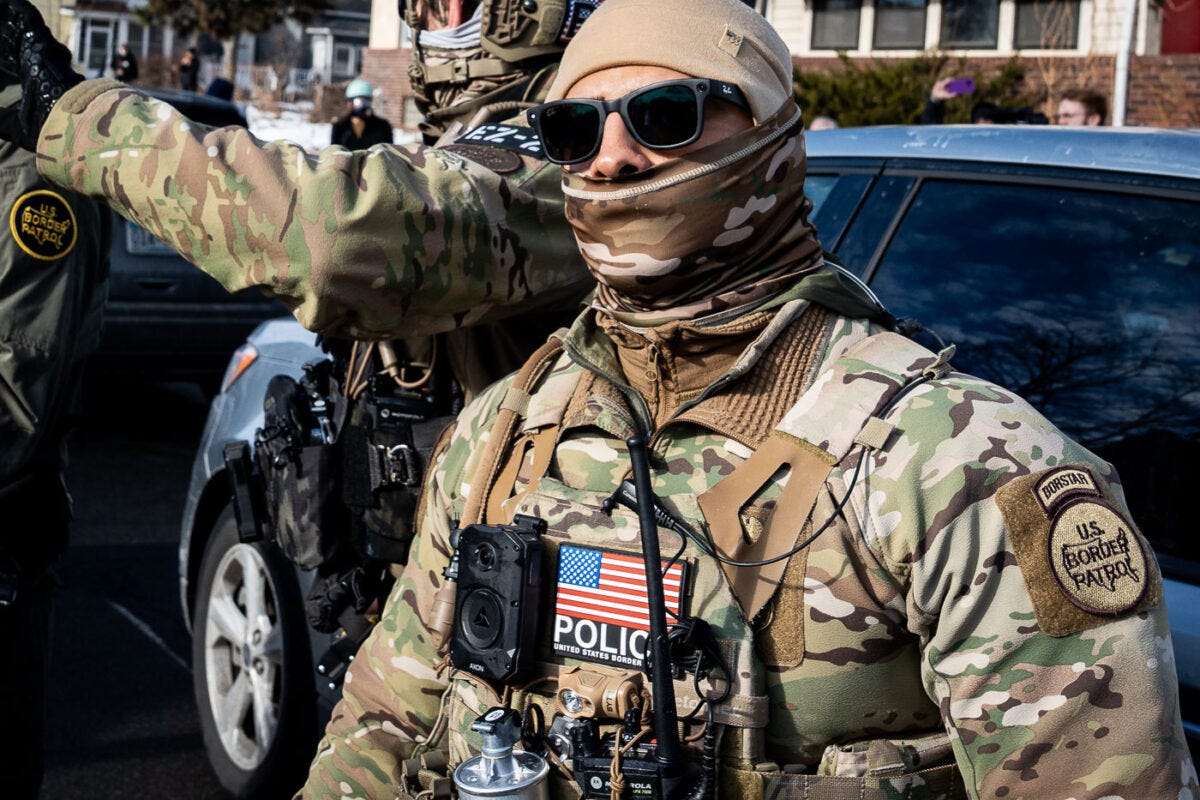
Meanwhile, ICE terrorists are running rampant in American cities, blatantly engaging in legalized racial profiling, ramming cars, shooting innocent people dead, tear gassing children, and expanding surveillance to implement the latest iteration of the police state.
As political scientist Samuel P. Huntington reminds us, “The West won the world not by the superiority of its ideas or values or religion, but rather by its superiority in applying organized violence. Westerners often forget this fact, non-Westerners never do.”
The U.S. government uses violence because, unfortunately, it works.
Resisting fascism
“To win any struggle for liberation, you have to have the way as well as the will, an overall ideology and strategy that stem from a scientific analysis of history and present conditions.”
— Assata Shakur
This brings us to resisting fascists.
We are living in a historical moment with parallels to 1934 Germany, after the Nazi party had seized power and was beginning to consolidate by criminalizing opposition, undermining fundamental civil liberties, rewarding loyal party members with jobs, political positions, and government contracts, and dismantling checks and balances in government and civil society.
Most of my writing here at Biocentric focuses on the ecological crisis, but there is no separating this from imperialism, fascism, racism, and patriarchy. As more people realize we live under a fascist regime, there is more appetite for radical action to oppose the fascist state and its cooperating elites. This is part of the reason why I write about sabotage: it is a classic tools in asymmetric struggles where one side has vastly greater power than the other.
By studying historical examples of resistance, we can learn lessons for our movements today. Because you can’t beat fascists by rational argumentation, not when they already hold power and are wielding it brutally.
Sabotage in history: Norway in World War II
This brings us to the focus of today’s article: a historical case study of a complex sabotage operation aimed at undermining the industrial machine of the Nazi regime during World War II.
Thomas Gallagher’s 1975 book Assault in Norway: Sabotaging the Nazi Nuclear Program details a Norwegian-British covert operation carried out over the winter of 1942-43. The story revolves around the nuclear arms race. By 1942, U.S. and British nuclear physicists had discovered that creating an atomic bomb was a scientific possibility. This frightened them to no end, since they knew well that Germany had the most advanced nuclear research program on the planet.
Assuming that Germany had at least a 2-year research advantage, they began to look for vulnerabilities in the Nazi research program that could slow their progress toward a bomb. They found the vulnerability in “heavy water,” a rare isotope of standard water that can only be isolated and concentrated through the use of vast amounts of electricity and a key material used in nuclear research.
At the time, the only facility in Europe capable of creating significant amounts of heavy water was the Norsk Hydroelectric plant at Vemork, in Nazi-occupied Norway. Hoping to stop the flow of heavy water to Germany, British and exiled Norwegian military intelligence hatched a plan to sabotage the Vemork plant and destroy the stockpiles of heavy water held there.
The plan was audacious. Vemork was a natural fortress, located in a steep mountain valley perched on a ledge on a steep cliffside. Aerial bombing was impossible, so the plan had to be carried out on foot.
In October 1942, four Norwegians tasked with reconnaissance and preparation parachuted onto the Hardanger Plateau, 3,500 square miles of wild, virtually uninhabited land. They survived there in remote hunting cabins for five frigid months, eating moss and reindeer, scouting the Vemork site, detailing the habits of guards and workers, and assessing approaches to the plant. Aided by a sympathetic local population, including workers at the plant, they gathered detailed intelligence.
In February, six more parachuted in. They connected with the others and created a detailed plan which involved approaching on skis, descending the precipitous cliffs at night, and planting explosives. Despite perilous risks, they succeeded, and all escaped successfully — five by skiing over 200 miles to the Swedish border.
Yet unlike many other World War II narratives, this is less run-and-gun firefight story and more tale of precision planning and bold action carried out using advantages of terrain, local knowledge, and intelligence. The story also relates the importance of physical fitness, backcountry navigation and travel, and survival skills that are essential for this kind of action.
Colonel John S. Wilson, leader of the Norwegian Section of the Special Operations Executive in British Exile during WWII, wrote after the war about what truly is needed for effective underground operations:
“The tough gangster type of detective fiction was of little use, and, in fact, likely to be a danger. Help and support to the Norwegian resistance could only be provided by [people] of character, who were prepared to adapt themselves and their views—even their orders at times—to other people and other considerations, once they saw that change was necessary.
Common sense and adaptability are the two main virtues required in anyone who is to work underground, assuming a deep and broad sense of loyalty, which is the basic essential.”
Adapting these strategies to today
Sabotage is just as useful as ever today — perhaps even more so, in an era in which complex chains of technologies and supply chains are required for even the most basic functioning of empire. Data centers, oil and gas infrastructure, weapons manufacturing, surveillance networks, and financial systems are all vulnerable to sabotage.
One concrete example comes from the UK, where the group Palestine Action has repeatedly engaged in sabotage actions against Israeli weapons manufacturer Elbit Systems. As my friend Christopher Ketcham reported in November for Drop Site News:
On a warm September night in 2020, in what would become the first of hundreds of acts of sabotage and vandalism, members of the UK-based protest group Palestine Action (PA) occupied the roof of a factory in the town of Shenstone, in Staffordshire, and started hacking at it with sledgehammers. The goal was to destroy the roof, make the site unviable, and stop production for as long as possible. Operated by Elbit Systems, Israel’s largest weapons manufacturer, the Shenstone facility specialized in the fabrication of drones that included so-called “loitering munitions,” otherwise known as suicide units. The purpose of loitering munitions, a hybrid drone-and-cruise missile, is to float for as long as possible behind enemy lines, await target acquisition, then self-destruct when dropped on the target. Loitering munitions have been used to horrific effect in the Gaza genocide.
The actionists had spent weeks scoping out the weaknesses at the Shenstone site. The factory had no guards posted at night, and the rooftop of the two-story building could be accessed simply by slapping a twenty-foot ladder against its side. In the darkness of the early hours of September 13, 2020, with the ladder positioned, they hauled their equipment onto the roof for an occupation planned to last five days. They carried tents, sleeping pads, a supply of food, many gallons of water, banners, spray-paint, and sledgehammers.
Once installed on the roof, the actionists went to work with the hammers. They bashed holes in the tarmac, broke windows, and smashed air conditioning units. They draped Palestinian flags on the façade of the building alongside a banner that said “SHUT ELBIT DOWN.” As day broke and the sun started to beat down, the exposed roof became a furnace and baked them. They held on for three days, negotiating with police who surrounded the facility.
…
The relentless raiding has been effective. In September, Elbit suddenly shut down another facility in Bristol that the group had targeted dozens of times. In 2022, after 18 straight months of PA actions— including break-ins, blockades, vandalism, and rooftop occupations—Elbit sold its drone-parts subsidiary Ferranti Technologies’ Power and Control in Waterhead. Hit so many times by PA, the Elbit factory in Tamworth permanently closed in March 2024 due to “falling profits and increased security costs,” according to a statement from the company. “The new owners,” reported the Guardian, “said they would not have any association with Elbit and cancel its defence contracts.” In 2022, Elbit lost out on a series of contracts with the UK government worth some $340 million, a loss which PA claimed credit for. Due to their constant disruptions, the group said, Elbit was now an “unreliable supplier.”
In some instances, the British public sided with actionists when they were brought to trial. In 2024, jurors refused to convict four PA members who caused $920,000 of damage to Teledyne, while two others were acquitted of criminal damage of Elbit’s Leicester factory. The public had figured out, Huda Ammori told me, that Palestine Action was “about valuing the lives of Palestinians more than the property and tools used to massacre them.” Sabotage and property destruction was okay if these were construed as acts against the machinery of genocide.
Sabotage is not a silver bullet that will solve all our problems. It can fail, and it can backfire. We should look at it as one tactic among many, each appropriate for certain circumstances.
Yet, it is often overlooked. Properly timed and targeted to maximize public support, brave actions of sabotage can shift political dynamics dramatically and contribute to a healthy ecosystem of resistance.
In these times, we need every act of resistance we can muster.
I rely entirely on readers to share this content. If you appreciate what you read here, please share on social media, discussion forums, and in direct messages to friends. Thank you.
Biocentric is a liberated zone with zero AI-generated content.
I have training in systems analysis.
Since my county is slated for its very own concentration camp I will utilize those skills.
"The U.S. government uses violence because, unfortunately, it works." - Something that those who oppose the current US administration would do well to remember.