

Past, Present, and Future Dead
The Nippon Dynawave industrial accident, Coffin Rock, and ecological collapse

Welcome to Biocentric, a newsletter about sustainability, greenwashing, and resistance to empire. I’m author and organizer Max Wilbert. If you want to follow, you can subscribe for free. Paid subscribers, in return for supporting this publication and the work you see here, receive access to rare private posts with behind-the-scenes reports and unreleased drafts.
“…sensitivity toward destructiveness-cruelty is rapidly diminishing, and necrophilia, the attraction to what is dead, decaying, lifeless, and purely mechanical, is increasing throughout our cybernetic industrial society… [this] threatens to become the secret principle of a society in which the conquest of nature by the machine constitutes the very meaning of progress, and where the living person becomes an appendix to the machine.”
— Erich Fromm, Anatomy of Human Destructiveness (1973)
It’s last November. My family and I drive to a small town on the Washington side of the Columbia River (called the Wimaɬ to the upper Chinookan peoples, Imaɬ to the lower Chinookans, and Nchʼi-Wàna in Yakama) to visit with a dear friend who is very ill. We pull off State Route 432 to refuel on the outskirts of the industrial riverfront city Longview, 40 miles from Portland.
As we wait, I wander across the parking lot. On the far side is a deep canal — “ditch number five,” a channelized tributary of the Columbia River. In this floodplain, now dedicated to warehouses and industrial sites, the river is forced into unnatural shapes. Overhead, high-power electric lines carry energy from hydroelectric dams, nuclear power plants, wind turbine arrays, and solar installations to industrial sites along the river.
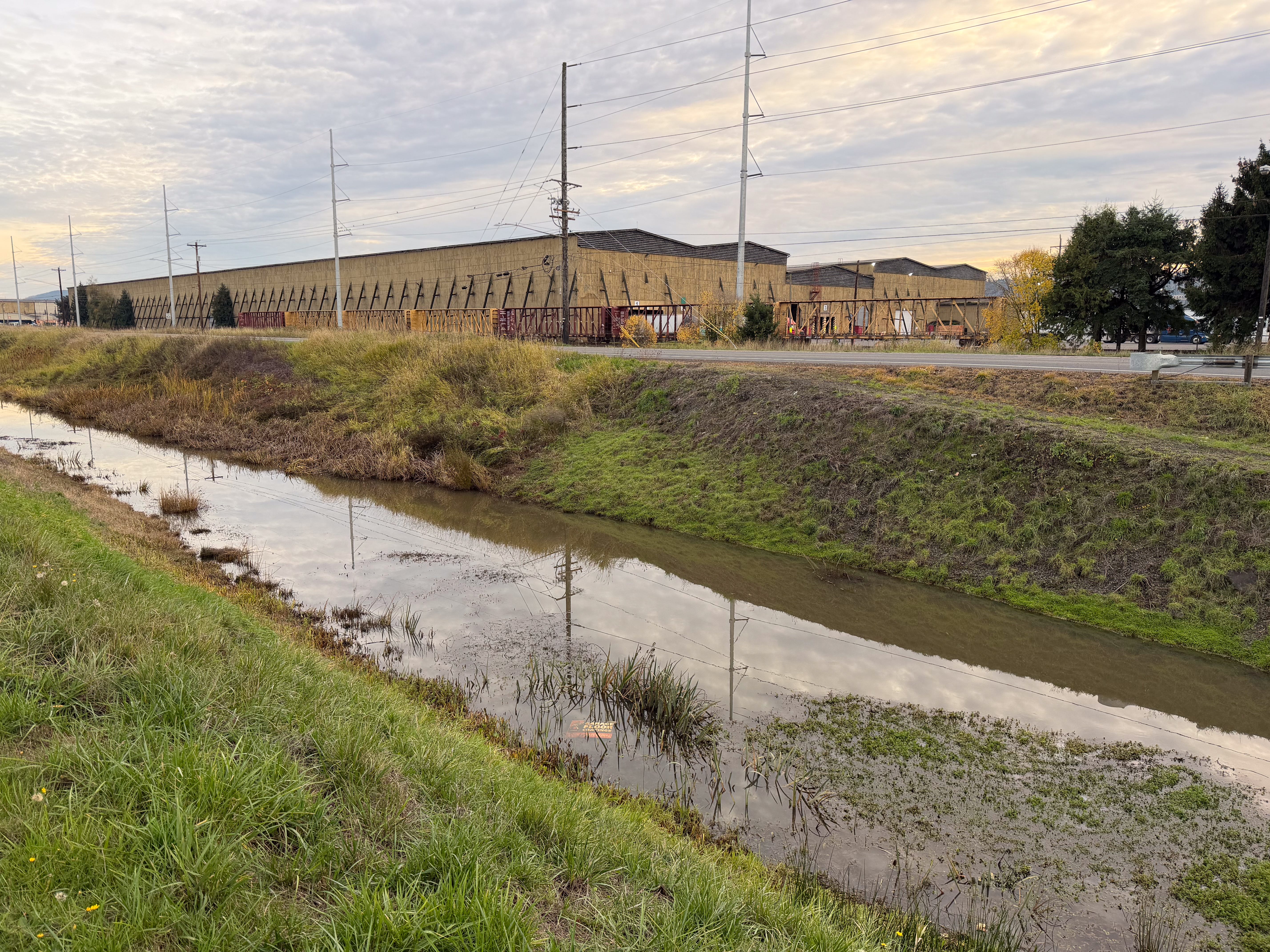
Across the road is one of those sites, built tight to the river to take advantage of its ability to carry bargeloads of cargo. A smokestack pumps great billowing masses of pollution into the air.
It is common in our culture to turn away from industrial atrocities. They are the dirty underbelly of modernity. Ugly. They make the cost of our way of life hard to ignore, and so most people simply let their eyes slide away. This is wrong. We must truly look in order to understand reality, and we must understand in order to change. I can’t look away.
The Nippon Dynawave facility in November 2025. Video by the author.
The Accident
What I did not realize that day was that the facility I was looking at was the Nippon Dynawave Packaging Company, a Japanese-owned cardboard manufacturing facility originally constructed by Weyerhaueser between 1953 and 1955.
Located directly behind the smokestack was a 35-foot-tall storage tank containing half a million gallons of an incredibly dangerous, highly toxic substance called white liquor.
That tank was about to fail.
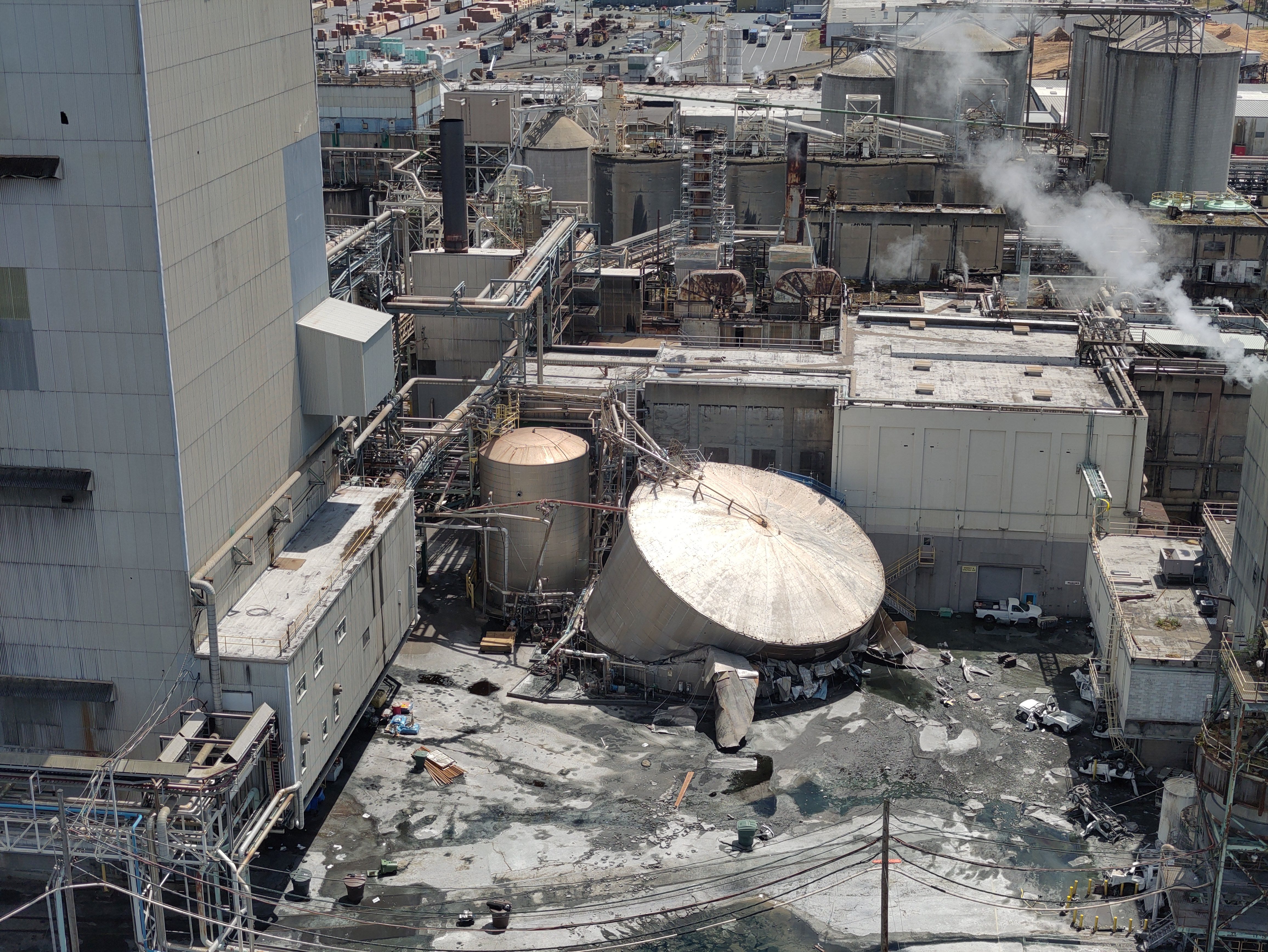
It happened just before 7:15am on the morning of on May 26th, 2026.
As dawn broke and workers arrived for shift change at the Nippon Dynawave plant, the structural integrity of the 35-foot tank failed spectacularly. In seconds, more than 570,000 gallons of a toxic chemical called “white liquor” spewed forth with enough force to flip cars and smash walls.
White liquor is a chemical solution made up of sodium hydroxide (lye) and sodium sulfide, and it is caustic — incredibly so. Measuring a 14 on the pH scale, it is one of the most “basic” substances known; material like that can kill a human being instantly, dissolving fats and proteins and eating through skin.
That is what happened. As 570,000 gallons of it cascaded across the work site, nine people were killed; two more would die in the hospital soon afterwards.
Their names were Gilberto Bernal, Tyler Covington, Dale Miller, Jared Ammons, Bradley Covington, Clinton Doran, John Forsberg, Norman Barlow, Robert Wilson, Braydon Finkas, and Dillon Miller.
Seven additional workers and one firefighter, responding to the scene, were sent to the hospital with injuries.
The white liquor mixed with water from a broken water pipe, flowed into the storm drains and then into “ditch number five” and into the Columbia. Dead fish began to bob to the surface. Underwater and along the shoreline, frogs, snails, insects, birds, small mammals, and other life forms died.


The Desecrated Burial Site
Weeks after the accident, I am looking at a satellite picture of the Nippon Dynawave facility, trying to confirm that I had indeed been looking at this facility on that dark November evening. I had been.
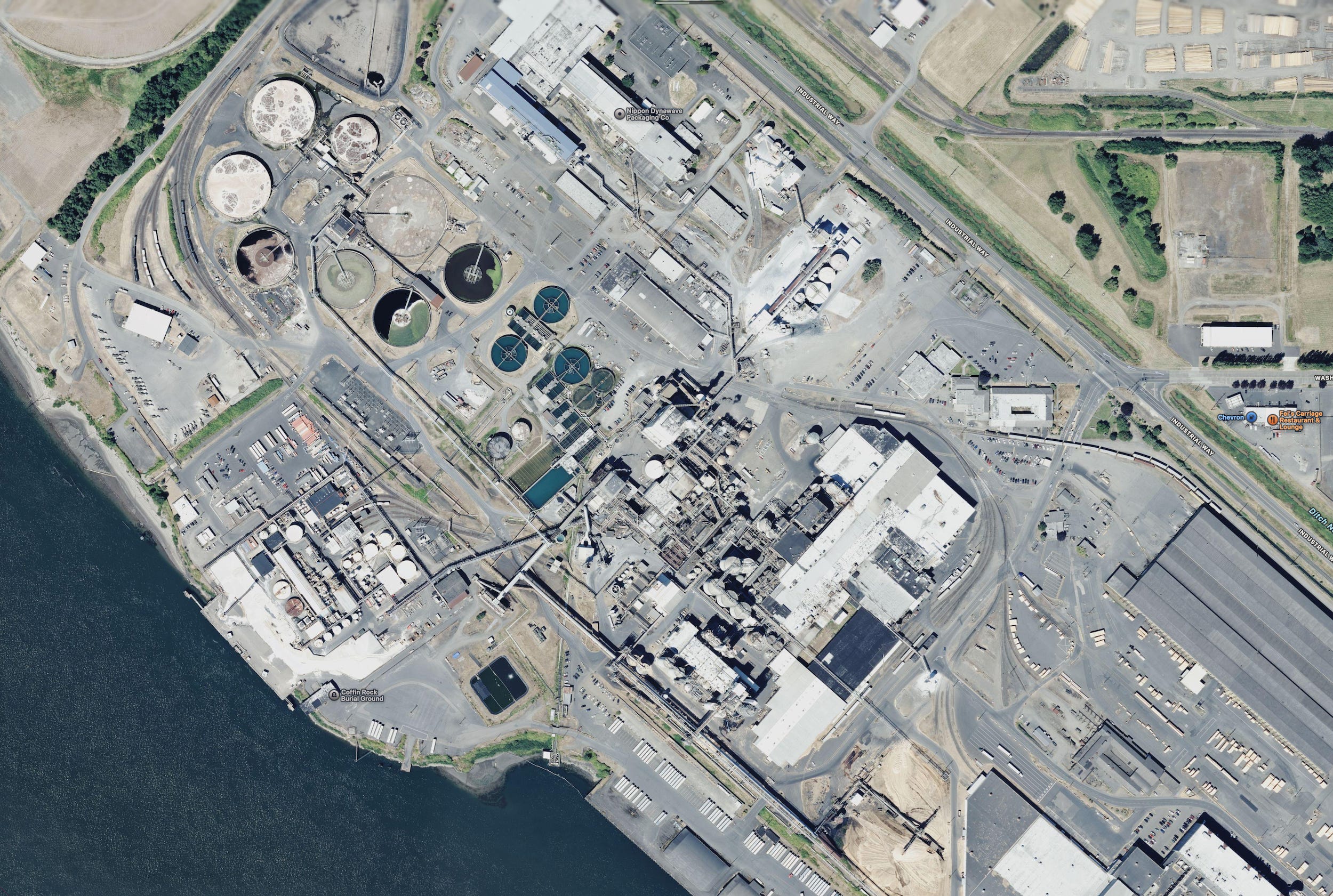
In the satellite image, the tank — visible as a white-roofed, round structure with cars parked on two sides of it — remains intact. Rail lines, digester tanks, docks for unloading raw materials, and the neighboring NORPAC facility, which purchases pulp from Nippon Dynawave and makes it into paper for use in printers, books, cardboard boxes, grocery bags, and more, are clearly visible.
But it is something else that catches my eye.
Near the river, in what seems to be the parking lot of the facility’s ship unloading area, a small label reads “Coffin Rock Burial Ground.” I click the icon. Nothing. I search the name. Still nothing. I go the second page of results, then the third, then finally find what I am looking for.
It is the history of this place, now buried under a chemically-contaminated parking lot. Stefan Krause tells the story:
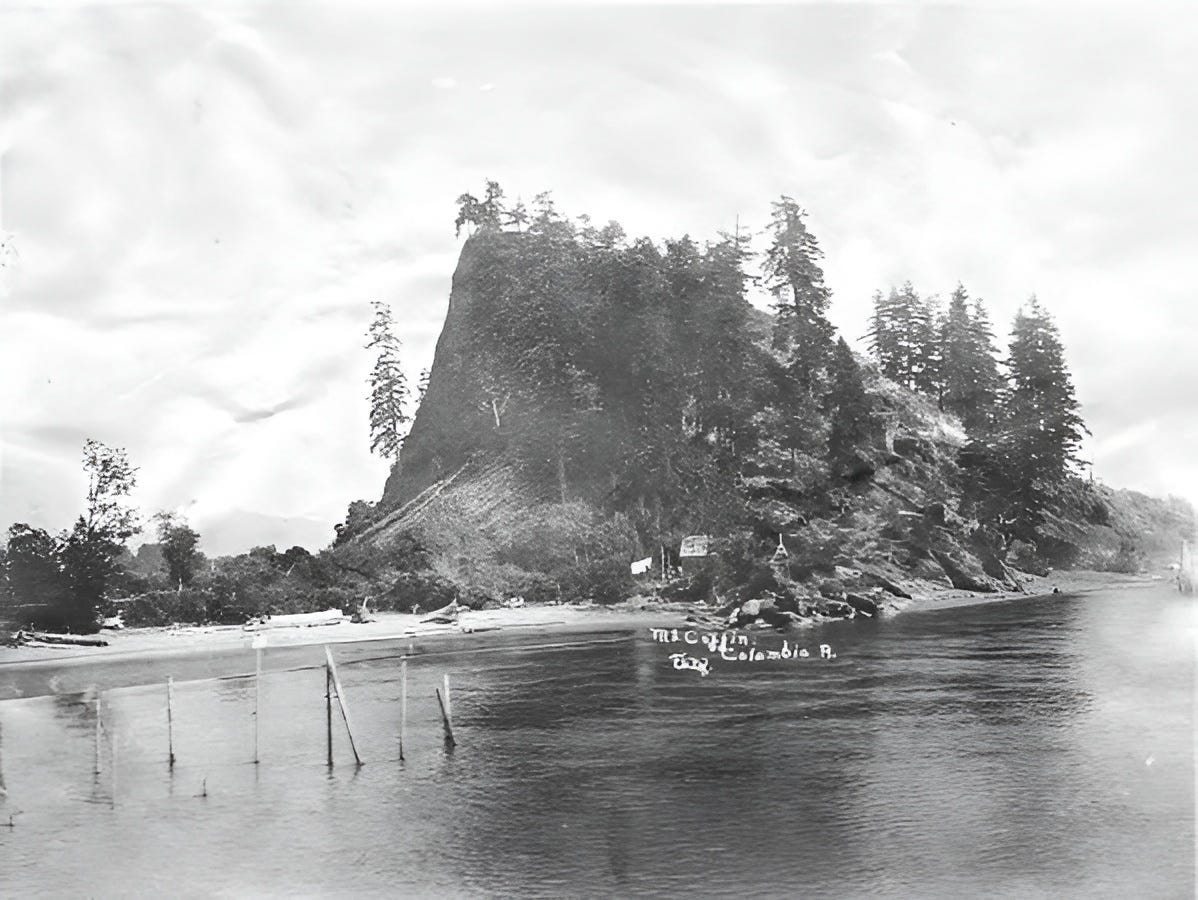
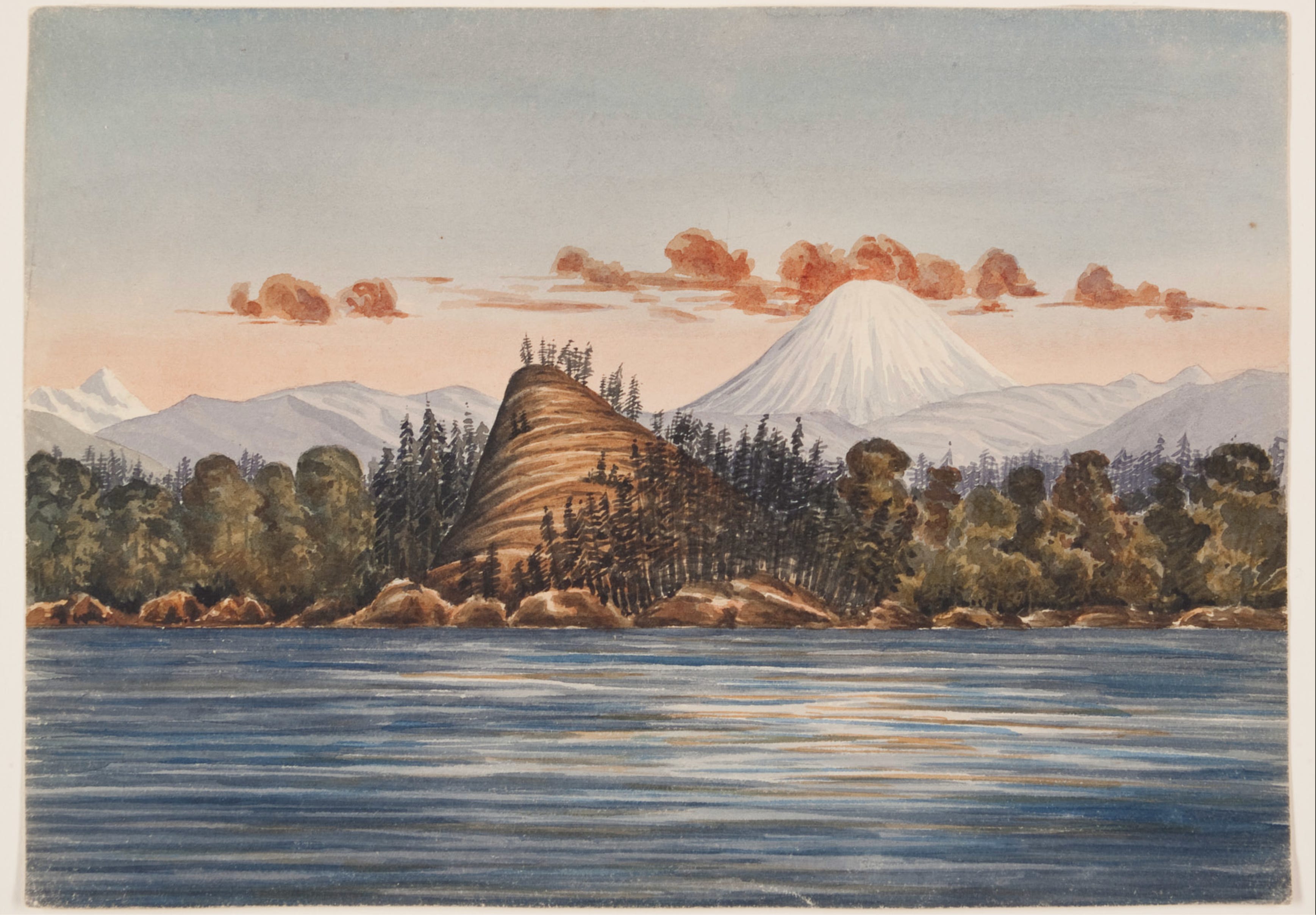
When Royal Navy Lieutenant William R. Broughton—commander of the HMS Chatham and important member of the Vancouver expedition—began his journey on the Columbia River in October 1792, he was the second European explorer in these waters. The American Robert Gray sailed down the river only a few weeks earlier and named it after his vessel: the Columbia. Broughton, however, drew a very detailed map of the river, recording and naming several geographical features along the Columbia River. One of these features “was a remarkable mount, about which were placed several canoes, containing dead bodies,” which he named ‘Mount Coffin.’..
In the following years several explorers mentioned the strange rock in their journals. In November 1805, the famous explorers Meriwether Lewis and William Clark passed by this landmark and described it as “a verry [sic] remarkable Knob.” In 1811, David Stuart of the expedition of the German-American merchant John Jacob Astor noticed Mount Coffin when he was journeying up the Columbia in order to set up a fur trade outpost. Stuart remarks that “[a]t one part of the river, they passed, on the northern side, an isolated rock… rising from a low marshy soil, and totally disconnected with the adjacent mountains. This was held in great reverence by the neighboring Indians, being one of their principal places of sepulture.”
Mount Coffin did not remain unmolested for long, as historian Bonnie Gilbert explains:
“The 19th century American naval lieutenant and explorer, Charles Wilkes… is responsible for the destruction of a large number of Native American graves in “Oregon Country” ... On the Columbia River, Wilkes and his crew stopped at Mount Coffin (near present day Longview, WA) to conduct observations atop the isolated… mount. Wilkes noted numerous Indian burial sites on the slopes, later writing: ‘The canoes used by the Indians as coffins are seen upon it in every direction, in all stages of decay. They are supported between trees, at the height of four or five feet above the ground and about them are hung the utensils that had belonged to the deceased, or that had been offered as tokens of respect.’
At day’s end, the crew departed for the brig without fully extinguishing their campfire which rapidly spread across the mount. ‘There was no help for it,’ wrote Wilkes… ‘The fire continued to rage throughout the night until all was burnt.’ It is estimated that three thousand funerary canoes went up in smoke that night. Wilkes placated local Indians by explaining the careless accident and giving ‘small presents,’ though [he] noted that a few years earlier it might have provoked a hostile attack. (Wilkes: 1845)
[However] the severely depleted native population was in no shape to mount a hostile attack on Wilkes in 1841. Contact with white explorers and traders had exposed the tribes to diseases like influenza, malaria, and smallpox, to which they had no immunity. The epidemic diseases spread like wildfire, decimating tribal populations. Prominent Chinook Chief Comcomly was among scores who died of the “Cold Sick” in 1830 and was buried on Memaloose Island, upriver from Mount Coffin. A British doctor with the Hudson’s Bay Company, Meredith Gairdner, located the site, decapitated Comcomly’ s corpse, and sent the skull to England for scientific study. Careless desecration of grave sites by whites and outright looting for skulls, body parts, and artifacts occurred frequently in the Northwest during the 19th century.”
None of this mentioned in the news accounts of the May 26th accident. And the story doesn’t end there.
The desecration of Mount Coffin did not end with fire. Patrick Wolfe describes colonial genocide as a three-phase process: (1) an initial confrontation, war, invasion, and/or extermination; (2) a carceration period involving forced displacement and resettlement; and (3) an assimilation period that aims to integrate remaining indigenous populations into the colonial system. With phase one largely completed and phase two ongoing (although Indian wars would continue for decades), settler-colonists began to flood into Oregon territory. Their first priority was resource extraction, and the Federal Government facilitated this process.
Between 1850 and 1871, 129 million acres in the western United States were “given” away by the Federal Government to railway corporations. This included, in 1862, Mount Coffin and the land surrounding it. In 1900, Frederick Weyerhaeuser, founder of Weyerhaeuser Timber Company, purchased 900,000 acres of this land, including Mount Coffin, from the railway corporations, and in 1924, with Robert Alexander Long, opened the Long-Bell Lumber Mill directly adjacent to the former funerary site.
At the time it was the largest lumber mill in the world. The forests began to fall en masse.
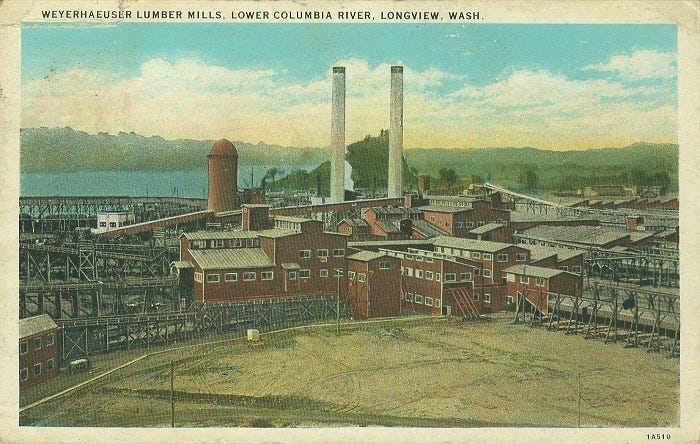
As the facility and the nearby port town expanded, demand for raw materials was insatiable. In 1929, workers dynamited Mount Coffin and quarried the site for gravel, perhaps for the mill itself, or for the expansion of the Port of Longview. Sometime in the intervening years, the flattened site of the sacred burial rock was buried under asphalt. Where once had stood tall trees, mossy rock outcrops overlooking a wild river teeming with salmon and hills cloaked in old-growth forests, where a people in intimate relationship with nature had laid their beloved dead to rest, now there was dust, oil spills, and tire grime.
Now in place of dead people came dead trees, whole tribes of them; entire peoples.
Between 1929 and 1960, the Long-Bell sawmill would process 8.7 billion board-feet of timber. A dense acre of old-growth Pacific Northwest forest might contain 60,000 board feet of timber, which means that the sawmill at Mount Coffin single-handedly deforested some 145,000 acres in those years. That’s more than 225 square miles, a square of land 15 miles to a side, or an area six times the size of San Francisco.
Perhaps this is a good time to remind you that the redwoods are not the tallest trees in the world; they are the tallest remaining. It’s believed that many Douglas Firs of the Pacific Northwest overtopped these redwoods, towering over 400 feet.
Remembering the Lost Giants

The Czech and French author and political dissident Milan Kundera once wrote that “The struggle of man against power is the struggle of memory against forgetting.” Although he wrote abo…


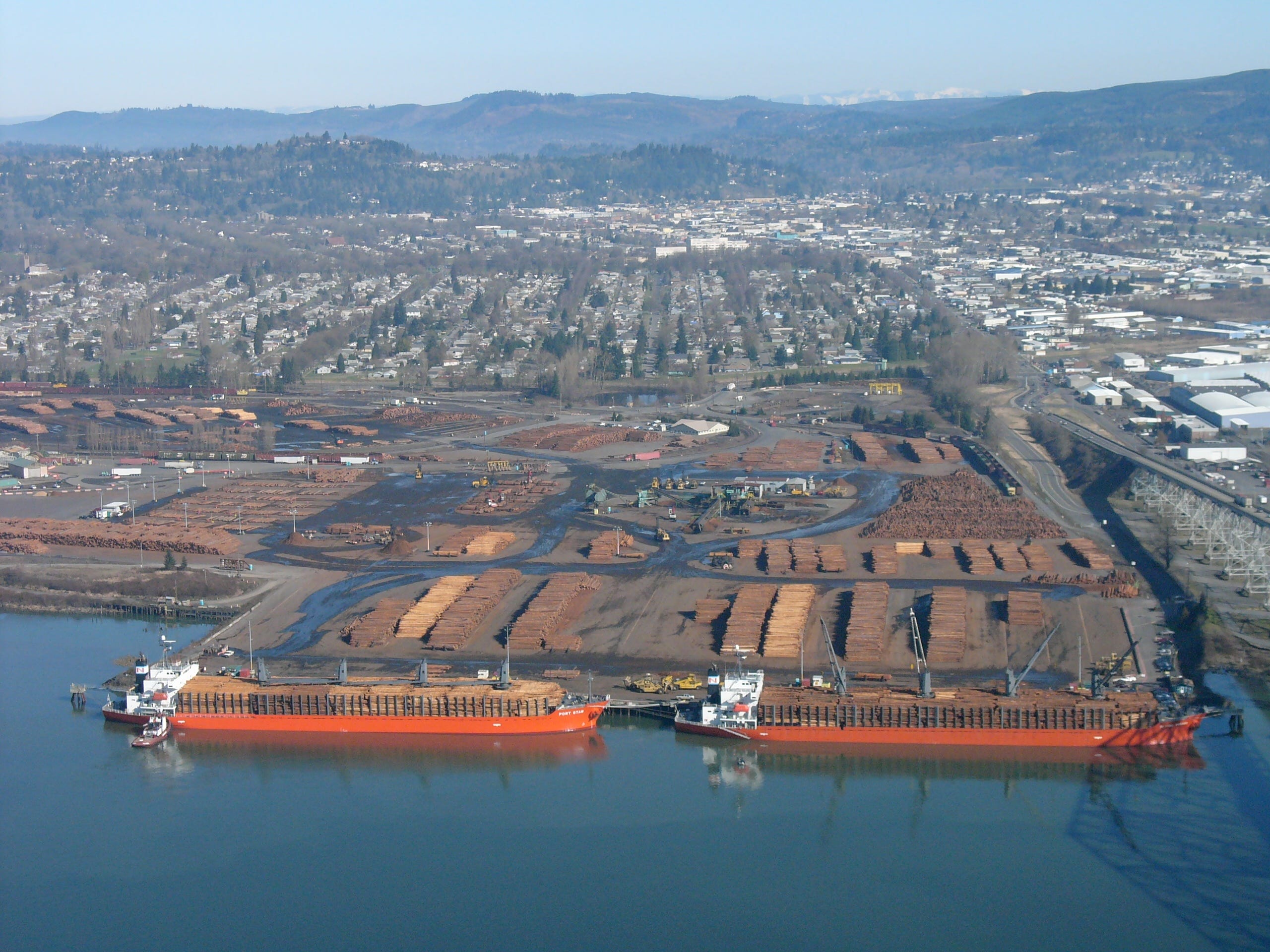
It’s last November. After pulling out of the gas station across from Nippon Dynawave, we’ve traveled downriver a few miles to Kalama. A day has passed. I’m sitting peacefully wit family and friends, watching the beauty of the river roll by beneath the bluff. And then there is this: a barge heavily loaded with thousands upon thousands of tree trunks made its way slowly upriver. It is probably headed towards the Port of Longview, and then the Nippon Dynawave facility.
Logs on the Columbia. Video by the author.
The desecration of these lands is not over. It continues, day after day. Violence against nature is embedded in essentially all of the products of modern culture — everyday things like paper and cardboard.
Paper is, of course, made from wood. Wood for paper pulp is primarily sourced from privately owned industrial forest lands — once natural places which have been turned into glorified cornfields, regularly traversed by feller bunchers, mechanized harvesting tools that obviate the need for human laborers, vast tracts of land regularly sprayed with millions of gallons of Roundup and other industrial poisons. A handful of private logging companies and family timber barons control an area in the lower-48 United States larger than Washington, Oregon, Idaho, and Arizona combined. That’s an area larger than all the lower-48 National Parks, wilderness areas, and cities put together. Today, the multinational Weyerhaeuser Company alone is worth some $15 billion and controls nearly 40,000 square miles of US and Canadian tree plantations — an area the size of Kentucky or Tennessee — or for westerners, more than 40% of the State of Oregon.
The violence of paper production used to be common knowledge among the environmental movement and the eco-minded public. Several decades ago, campaigns to pressure paper and timber industries to alter their methods, protect biologically and culturally important sites, and reduce toxin use, alongside work to implore the public to recycle paper and simply use far less of it, made up a prominent swath of environmental efforts.

Today such work seems almost quaint in the era of data centers, AI, space launches, and beyond. Almost no one is campaigning around issues of paper anymore. That has become part of the background of industrial society, part of what I call the “inverse shifting baseline syndrome,” where, as we become gradually accustomed to ecologically impoverished landscapes over long decades and generations, at the same time we come to expect that something like paper production will always be there; that car culture is entirely normal and will exist indefinitely into the future; that the products of industrial modernity and the progress it represents can never be stopped, only adapted to.
But even amidst such a landscape of loss and resignation, the violence behind paper, just like the violence that underlies plastic, automobiles, fossil fuels, roads, computers, the internet, and so many other components of our modernity, bubbles to the surface over and over again. The contradiction between modern society and ecology, as well as workers and human health, is inherent. It will never disappear. It can only be temporarily buried. Or forgotten.
In the aftermath of the BP oil spill in the Gulf of Mexico in 2010, satirical newspaper The Onion ran a story that summed up our environmental crisis and the sad state of our ecological consciousness better than perhaps all the staid reports ever could. The headline reads: “Oil tanker successfully reaches port in major environmental catastrophe.”
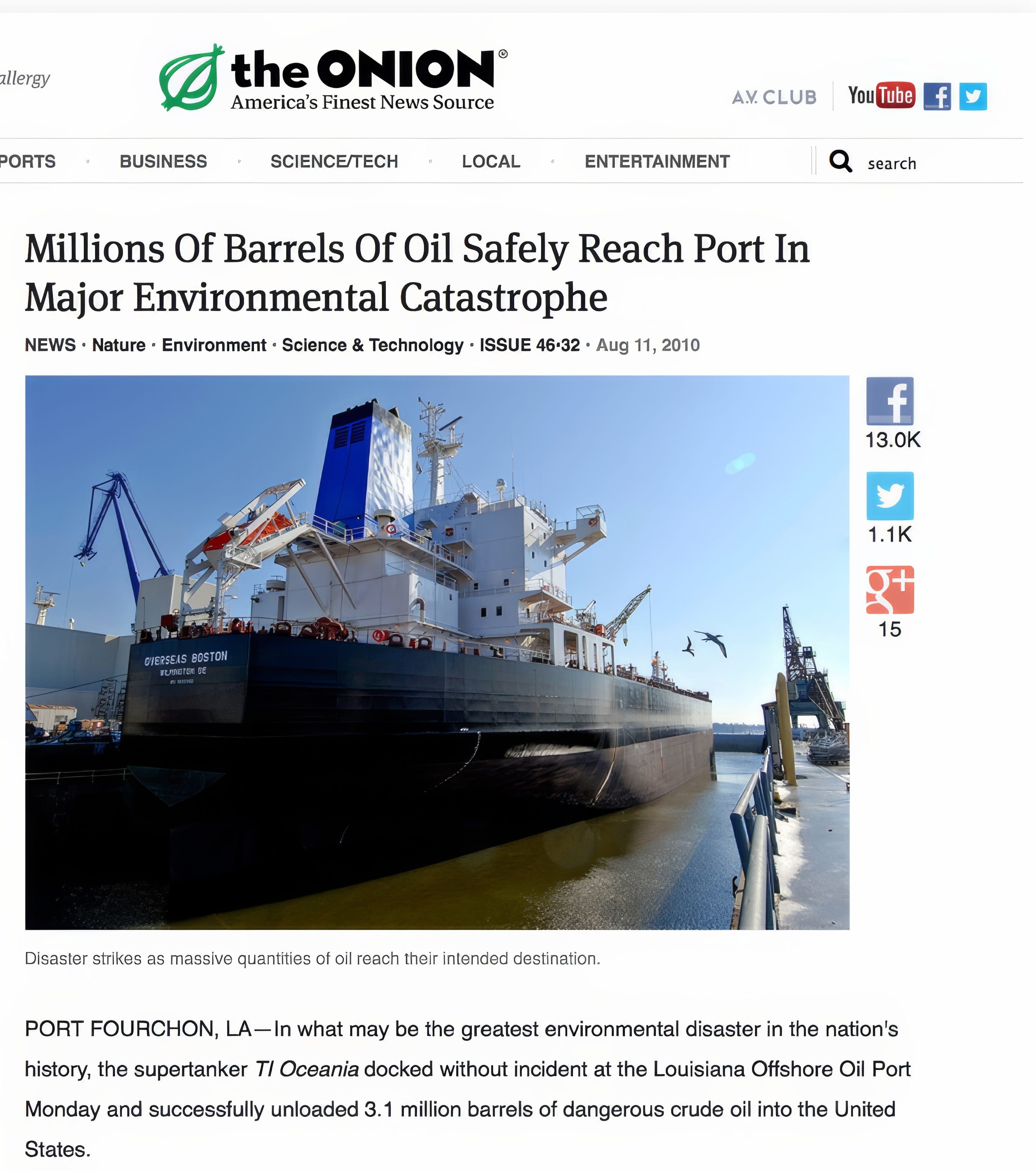
Washington governor Bob Ferguson called the Nippon Dynawave accident in May the worst industrial accident in the last century in the state. And yet what is shocking to me is that, like The Onion reminds us, the true disaster is perhaps not the spill — which is, of course, a tragedy — but the regular day-to-day operations.
Records show that Nippon Dynawave releases some 375,000 tons of greenhouse gases per year. The facility has been in more or less continuous operation since the 1950s, which means cumulative emissions could total more than 20 billion tons. Using the calculations derived from this paper which calculates deaths per ton of carbon emissions, that means that this facility, via the carbon pollution that it releases alone, could be responsible for more than 5,000 human deaths due to global warming over the next 80 years or so: people killed in their homes by new category six hurricanes, people starving in poor nations due to heat waves and crop failures, people dying of heat stroke under domes of previously unheard of temperatures.
What’s more, if we factor in the emissions associated with logging 145,000 acres of old-growth forest between 1929 and 1960 at the Long-Bell sawmill, this facility is responsible for something in the ballpark of 75,000 future deaths due to global warming — and that doesn’t include all the logging that has taken place between 1960 and the present. It also doesn’t include cancer and other illnesses caused by other toxic chemicals associated with these operations, or the carbon emissions and pollution released in the process of smelting the steel for the machinery on-site, etc.
It’s no exaggeration to say that operating this facility could easily cost 100,000 dead human beings. And still, we’re not accounting for the deaths of the indigenous people who had to be removed from their land in order for it to be built, or the death toll of non-humans.
Industrialism is murderous.
And what we call an environmental disaster really only refers to the occasional, predictable breakdowns in organized, deliberate systems of ecological devastation and long-term genocide.
The future
Writing about the eco-crisis, the spiritual bankruptcy of modern civilization, and the importance of resisting the industrial onslaught, I sometimes stumble across these stories. These are not accidents.
It happened at Peehee Mu’huh, known in English as Thacker Pass, where, when looking for written stories to supplement Northern Paiute oral histories of a massacre of Numu people committed by the U.S. Army in 1865, I came across the only written account of a survivor in the writings of William “Big Bill” Haywood, a legendary radical labor organizer and “wobbly” (member of the Industrial Workers of the World).
The story of his meeting with Ox Sam near Peehee Mu’huh in the 1870s had previously gone unnoticed amidst our fight to stop the mine. But I’d been hearing stories of Bill Haywood since I was a child watching singer and labor movement historian Utah Philips play at the Vancouver Folk Music Festival. I’d read his story in Howard Zinn’s essential A People’s History of the United States, and learned more of it from a professor at Seattle Central Community College.
Years ago, a friend wrote about how those who resist are “holding hands through history” with those who came — not just Bill Haywood and Ox Sam, but Steve Biko, Aldo Leopold, Mandela, Che, Thomas Sankara, Susan Griffin, Spartacus, John Brown, Sophie Scholl, Vine Deloria Jr., Andrea Dworkin, Ann Hansen, Tecumseh, Harriet Tubman.
The dead are here with us, and they are still telling stories — if you are ready to listen.
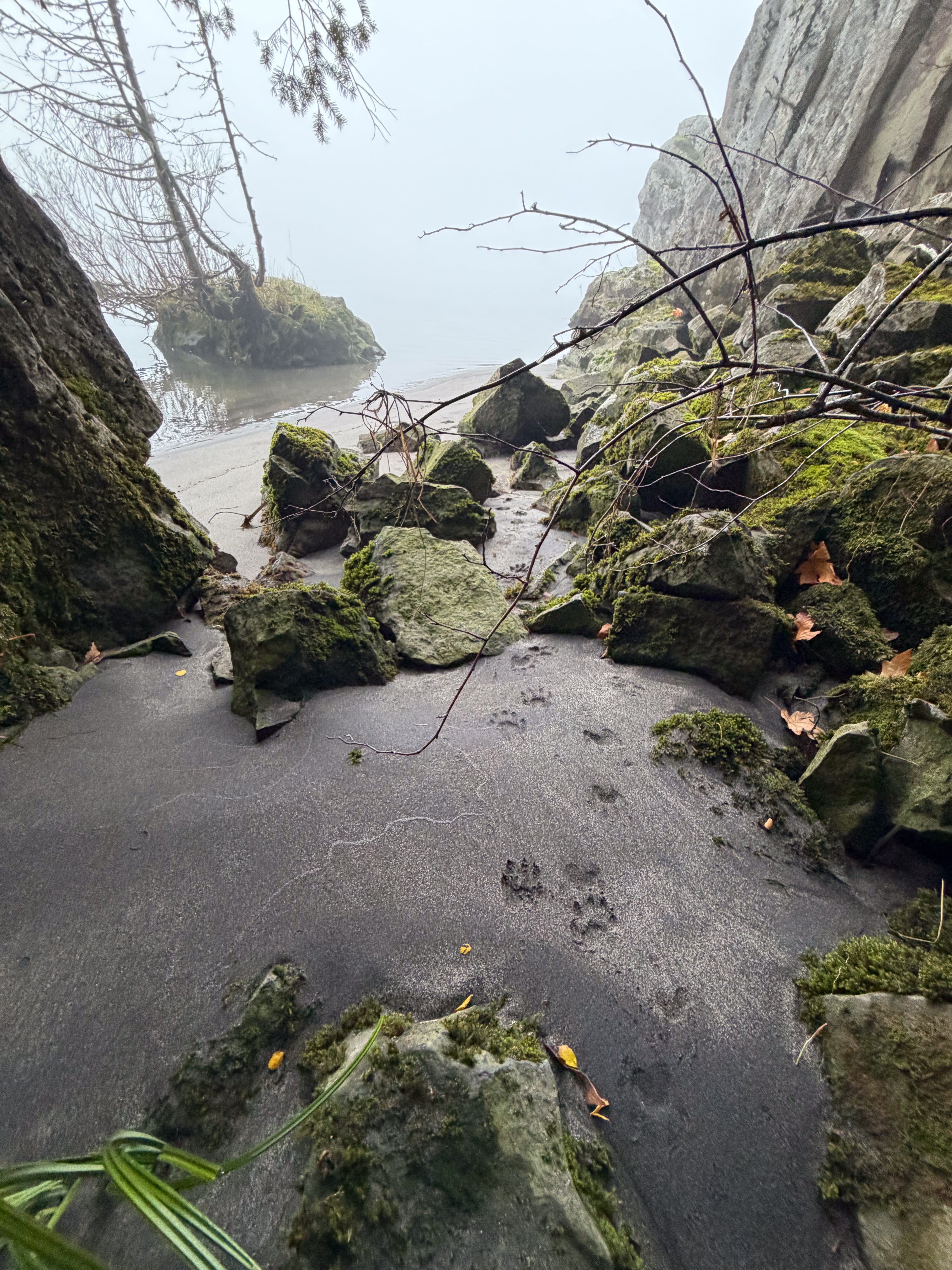
A being as vast as the Columbia is hard to kill. She is still alive. Yet she is dying. Year after year, her waters grow warmer and more difficult for native fish to survive in. Her salmon are dying, with fewer and fewer wild fish, the illusion of their persistence only maintained through a vast network of fish hatcheries, factory farms where eggs are raised into fish like cattle on a feedlot and released for anglers and commercial fishermen to gather into their nets. Her sturgeon, her steelhead, her freshwater mussels and lamprey and all of her inhabitants are dwindling. More than 60 large dams on her mainstem and tributaries shackle her. Her watershed has been deforested, urbanized, poisoned. The soils of her slopes, formerly nurturing wild ecologies, now erode under mechanized plows, carrying chemical fertilizers and pesticides into her waters. Millions of acres of her lands have been buried under concrete and asphalt, a veil of bitumen (tar sands). Wind turbines strike her ferruginous hawks and golden eagles out of the sky. Nuclear waste seeps into her waters at Hanford, where the plutonium that was used in the atomic bombings of Japan was enriched. Data centers take ever more of her flow, stealing the cold, life-sustaining waters that come from her mountains and necessary for her health and returning it superheated and toxified with chemicals. Up and down her length, industry has had its way.
She is in a cage, and the bars close in tighter and tighter every year.
Yet in those places where people make room for her to heal, she has done so, at least in part. Along the White Salmon, the removal of a dam led to salmon returning where none had been seen for decades. This is essential. But unless the destruction is stopped — not just stopped, but reversed — then there is only one end for her.
The great abolitionist Frederick Douglass, when he spoke of escaping slavery in 1838 in Baltimore, said that “I prayed for freedom for twenty years, but received no answer until I prayed with my legs.” I’ve loved this quote ever since I first read it. It carries layers of meaning. A course atheistic reading would, of course, be that god (or spirits, deities, etc) is not real; that our world is purely material, and prayer is nothing but affectation. But this isn’t what Douglass meant. He meant that we are instruments of divine will; that human action is a mechanism of intervention; that his desire for freedom would amount to nothing until it animated him.
My friend Julie Lomboy, an enrolled member of the Confederated Tribes of Grand Ronde, is currently on prayer walk from the mouth of the Columbia River at Astoria to the nuclear site at Hanford. She has been walking for days now, passing Vancouver, Washington a few days ago and continuing up the gorge. I will be joining her soon, to walk with her for the few days that I can. I will soon be launching a Biocentric grant program to provide support directly to grassroots resistance initiatives and those who face imprisonment and repression for this work. I’d like Julie to be one of the first recipients. Your support makes this possible.
For Frederick Douglass to be free, he had to walk. Walking will not free the river. For the river to be free, the dams must come down, the chemicals must cease, the data centers must be stopped, the watershed must be restored. And more. These are not easy tasks. They are straightforward ones, but not easy. Thousands of people have dedicated their lives to this work, and yet things are still moving in the wrong direction. We have not sacrificed enough. We have not done enough. We pray for the courage to do what is necessary.
The river is telling us what to do. We are too distracted to listen. We rocket past her in cars and trains. We “recreate” on her waters and drown out her voice in conversation and music. We drown her voice under the mechanical rumble of chainsaws, tractors, construction cranes, tugboats.
We must learn to listen.
Biocentric is a liberated zone with zero AI-generated content. I’m not on social media, so I rely on readers to share.
Max, this piece is equally painful and essential to read. Thank you for taking the time and bearing the anguish of recounting the history and the current desecration of our kindred beings. Your act of witness summons us to act—to pray with our feet—so that we don’t succumb to despair in the presence of such insidious violence.
This is a fine piece of work Max, tying so many present and past events together. I was aware of the Nippon tank failure, but your writing put a human face on it that can't be found in the MSM. So few of us are aware of the depth of the problems we face, and even the simplest and most obvious solutions evade us. About two miles from where I live stands an enormous vacant lot with signs for commercial development on it on the edge of a poor neighborhood. It has been there for at least five years since I returned to Buffalo and begs to be turned into a green space that would provide shade, a patch of habitat and improve community health, but no, it just stands in a stretch of urban blight. Honestly, I think we're cooked as we watch heat hammer Europe with a monster El Niño just getting under way. Still, I take some solace in being part of a community that recognizes our plight. Thank you for this intense, heartfelt work.
My latest: https://geoffreydeihl.substack.com/p/the-kitchens-on-fire