

Too Much Awareness, Not Enough Action
“Once there is seeing, there must be acting. Otherwise, what’s the use of seeing?”

Welcome to Biocentric, a newsletter about sustainability, greenwashing, and resistance to empire from author and organizer Max Wilbert. If you want to follow, you can subscribe for free.
Writing in The Dark Mountain Project last month, artist Richard Koscher discussed the futility of raising awareness:
“The phrase [raising awareness] does not invite thought,” Koscher says.
“…How many times have you seen an image, nodded quietly, felt a small tightening in your chest, and kept scrolling. The ice is melting. Awareness raised. The forest is burning. Awareness raised. A painting is stolen. Awareness raised. The planet is warming. Awareness raised. What happens next is rarely mentioned. The phrase implies that something has been accomplished. Recognition becomes a conclusion rather than a beginning.”
Koscher’s words resonate with an idea I have been becoming increasingly convinced of since attending journalism school twenty years ago: there is too much awareness, and not enough action.
Too many journalists, not enough activists.
Too many storytellers, not enough revolutionaries.
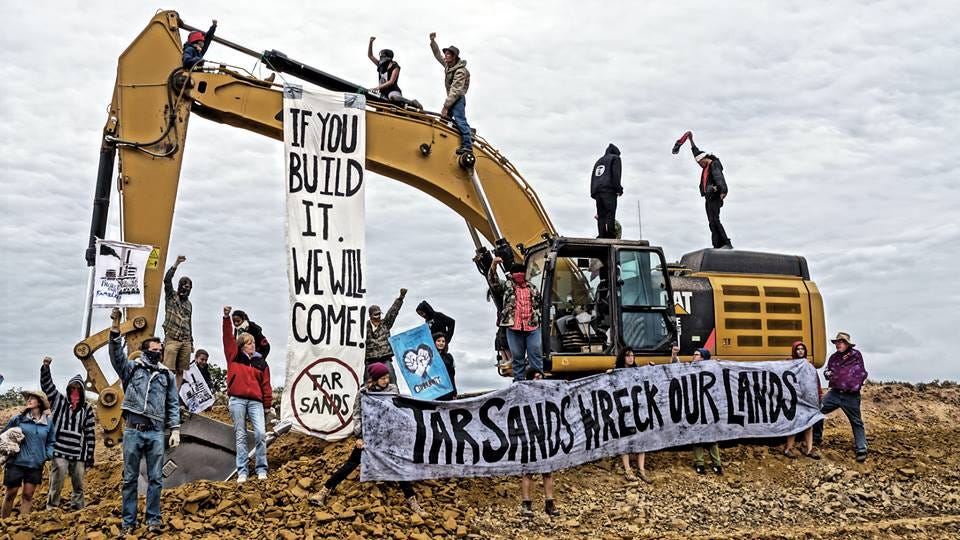
This point was hammered home at Peehee Mu’huh, known in English as Thacker Pass, where myself and many others fought the construction of a 18,000 acre open-pit mine on a sacred, biodiverse mountainside. Over the course of three years of protest camps, rallies, community organizing, federal lawsuits, threats, surveillance, and direct action, thousands of journalists and storytellers visited camp or amplified our story. We were on the front page of The New York Times and Le Monde. We were interviewed on CNN and NBC and NPR. We were featured in The Guardian and The Hill and Politico and all the regional newspapers. Local TV stations, alternative media outlets, and independent podcasts and radio shows covered the resistance. Multiple films were shot and produced. Musicians made songs. Poets wrote poems. Students wrote papers and theses. I was interviewed hundreds of times. Social media influencers and grassroots activists told the story in social media over and over and over again.
Yet in 2023, when the lawsuits failed (as we had warned they would) and the bulldozers began to roll, the time came for direct action to stop the mine. And despite all our work, barely a dozen people showed up.
Why is that?
Koscher writing in Dark Mountain, continues:
“Awareness has quietly become a moral finish line.
The danger is not that people do not care. The danger is that caring has been compressed into a moment so brief it requires nothing of us beyond acknowledgment. Once we know, we are done. We have fulfilled our obligation. We are free to move on....
We live in a culture where millions can watch a climate documentary, feel briefly moved, and return to lives structured in exactly the same way as before. Emissions continue to rise. Systems remain intact. Attention moves on. The illusion of progress is comforting. It allows us to feel engaged without being implicated.”
And implicated we are, because inaction is ultimately a choice.
Our campaign at Peehee Mu’huh changed hearts and minds. We educated hundreds of thousands, possibly millions of people about the environmental costs of lithium mining. Our work led many to question green technology’s viability as a method to solve the climate crisis which I believe is essential to actually charting a reasonable course forward.
And yet despite this, the land was destroyed. All that changed was ideas — ephemeral, weightless, internal. In the physical world, the bulldozers clanked and rattled as they crushed old-growth groves of sagebrush and animal burrows and Numu burial places. In the physical world, nothing changed.
My friend, the brilliant revolutionary and Hawaiian sovereignty activist Keala Kelly channeled the anger that myself and many others share about this in her recent essay excoriating the decline of the Hawaiian sovereignty movement in the face of relentless settler-colonial tourism and militarism in Hawaii. She writes:
“Every inch of Hawai‘i is a crime scene, and justice is on the side of an unnamed road, thumb outstretched, looking for a ride to anywhere but here… The Hawaiian world is deeply fractured and being actively carved up... And I am not willing to narrate our ruin like a journalist with no conscience or an umpire calling strikes and outs.”
“Narration of ruin” is practically a job description for many people these days.
Keala’s bone-deep rage, and the commitment to action that it engenders, mirrors my own. I’ve been terrified in the face of ecological apocalypse since I was 12. The crisis came to my attention not by reading reports or watching videos, but because I was embedded in a youth activist group and surrounded by people who were actively trying to change the world for the better. That was more than 25 years ago. In the intervening time, as our world has become increasingly dominated by the internet, I have observed the rise of the armchair analyst. They must have existed beforehand, but these days, they are a dime a dozen: people who write, host podcasts, post on social media, or work as journalists covering the industrial-scale destruction of nature without actually doing anything to stop it. They are narrators of ruin, and there are many of them here on Substack.
To be clear: some of these people are my friends, and I believe that education is important. Some people face real limitations preventing them from taking action. But most of us do not. Our limitations are self-imposed. They are imaginary. They stem from our fear.
The destruction of the planet is not simply a mistake or an accident that we can educate people out of; it’s a deliberately-constructed material arrangement of economic systems, machinery, energy flows, and systems of power which can be confronted and dismantled. Yes, it has an ideological superstructure supporting it and emerging from it, and the two components, material and ideological, are mutually reinforcing. But the material is primary.
Too many of us are content to believe that raising awareness — or having our own mind changed by the things we read or watch — is enough.
It’s not.
As Thich Nhat Hanh reminds us in his brilliant book Zen and the Art of Saving the Planet, “Once there is seeing, there must be acting. Otherwise, what’s the use of seeing?”
The point is to change the world, not simply to understand it.
To do so requires courage. I’ve been reflecting lately on the words of Arundhati Roy, the Booker Prize winning author and dissident who has been charged with sedition and brought up before the Indian Supreme Court for her support for Kashmiri independence, opposition to dams and other infrastructure megaprojects, opposition to the Israeli terrorist state, and support for the armed Naxalite revolutionary movement.
In an essay on the dumbing down of resistance movements, Roy wrote:
“Real resistance has real consequences.”
This line runs circles in my mind.
It is the real reason we have so many storytellers and so few on the front lines. It is far easier to understand the world than to change it. It is far easier to tell a story than to do something that is worthy of a story.
It is far easier to write or make films or music or poetry or photographs or public presentations than it is to sacrifice your time, your energy, your well-being, your reputation, your financial stability, your physical safety, and possibly even your life on the front lines of resistance campaigns.
This is why only a dozen people showed up for direct action at Peehee Mu’huh: because real resistance isn’t easy. It has consequences. It’s physically demanding. It’s exhausting. It’s thankless. The pay is either shitty, non-existent, or sometimes negative. It’s scary as hell. Violence is a real possibility. It involves very real, very large sacrifices. I’ve been sued, threatened with violence, smeared, physically assaulted, detained by police, surveilled, harassed by the FBI, risked serious injury, and nearly destroyed some of the most important relationships in my life while engaging in frontline resistance. And I haven’t done nearly enough.
We need more risk taking.
I’m very supportive of independent media. I studied journalism, became a writer, and authored two books because I believe in the power of stories to change the world. But this publication, and all my work, is not aimed mainly at raising awareness. I am not asking you to change the way you think. I am asking you to change the way you act. I am asking you to do difficult things.
I am asking you to fight.
Because, as Ai Weiwei says, “A small act is worth a million thoughts.”
This is the heart of why we have so many journalists and storytellers and independent media outlets in this time, and so few on the frontlines of resistance: because resistance is hard, and we do not have enough courage.
The origin of the word courage is the Latin word “cor,” which means “heart.” We need more courage in this time. More heart. More love. Because that is what overcomes fear and carries us to action. That is what gives us the strength to sacrifice for something bigger than ourselves.
This is a challenge to all the writers, podcasters, live streamers, social media users, keyboard warriors, narrators of ruin, and resistance media consumers out there: put down your phone. Shut off your computer. And try to find some way to change the world, physically, here and now. Build a revolutionary movement. Take direct action. Stop the flow of fossil fuels. Defend a forest or other natural place. Battle a data center or housing development. Find what you love, and defend it.
Raising awareness is not enough.
We need action.
Biocentric is a liberated zone with zero AI-generated content. Please note that I’m not on social media, so I rely on readers to help share and distribute this content.
Paid subscribers support the work you read about here, and in return receive access to very occasional private posts with behind-the-scenes information and unreleased drafts. Thank you to everyone who is able to support in this way.
What’s Coming Next
Confronting the nuclear myth.
A recording of my live stream with Will Falk on the $49,890.13 fine we’re facing, our fight against it, and broad movement strategy.
More on sabotage.
I am really taking this to heart, Max. As someone who works on the media side of Extinction Rebellion PDX, and has worked and may again work for Veterans For Peace Climate Crisis and Militarism Project, I have always told myself: well, this is what I can contribute - thinking, reading, writing, editing, speaking, helping others to speak in public. I'm pretty old, have health problems, and dread being arrested again, let alone jailed, just the physical experience of it (and I have never been beaten, as you have). But I have been thinking lately, before I read this essay, about exactly this: too many commentators, too few people taking action, especially MATERIAL or DIRECT, not symbolic action. I'm thinking about what I can change in my life. The end of my life is coming more into view. How can I "finish strong" as my personal trainer used to urge me? I'm reading "At Work in the Ruins" by Dougald Hine of the Dark Mountain Project, about how he came to the end of speaking publicly about climate change (crisis, breakdown, emergency) because after years and years of little to no real action, what more is there to say? And here I am writing too much... Anyway, thanks so much for these thoughts, and may they spark real action and feed our collective courage.
Beautifully said Max. I deeply, deeply agree. There are so many ways to manifest direct action in the physical world. Confrontation at the frontline is critical, but so is much else. All of it is needed. Urgently.
I read it here again and again: 'I agree with what you are saying but I am to [... insert excuse here ...]. My contribution is to educate.'
Staying in the thought space doesn't 'do' anything. Doesn't save anything. Stop anything. Action anything. Doesn't prepare for anything.
In truth, writing in this online space adds to the toll on the planet. It has consequence. So talking without doing is a negative sum game. Every commentator should be doing both. Words + action. Otherwise you are telling your readers to be exactly the same.